China Best Piezoceramic Actuator Manufacturer?
Choosing the China Best Piezoceramic Actuator manufacturer requires more than comparing prices, product photos, or catalog claims. A reliable supplier should demonstrate material knowledge, process control, and consistent testing. Its engineers must understand displacement, blocking force, resonance frequency, capacitance, hysteresis, and thermal stability. These details directly affect performance in valves, optical stages, medical instruments, and precision positioning equipment.
Professor Kenji Uchino, a leading piezoelectric materials expert, wrote, “Piezoelectric actuators are the muscles of smart materials.” This comparison is practical. A small ceramic stack can move a precision component by only a few micrometers, yet it may respond thousands of times during one operating cycle. The manufacturer must control electrode alignment, ceramic density, bonding quality, and insulation resistance. Even a tiny internal defect can create unstable motion or premature failure.
Evidence matters more than impressive language. Buyers should request dimensional reports, frequency-response data, aging results, and samples from the intended production line. ISO certification can support confidence, but it cannot replace technical verification. Ask how the supplier manages batch variation. Ask whether testing continues after assembly.
The “best” manufacturer is not always the largest one. It may be the partner that explains limitations clearly, supplies traceable data, and adjusts the Piezoceramic Actuator to the real application. Some specifications remain uncertain until testing begins. That is normal, but ignoring the uncertainty is not. A careful sourcing process should compare prototypes, inspect documentation, and confirm performance under actual voltage, load, temperature, and duty-cycle conditions.
Piezoelectric Actuators Explained: PZT d33 Values of 200–700 pC/N
China Best Piezoceramic Actuator Manufacturer?
Piezoceramic actuators convert voltage into controlled mechanical motion. Their key parameter is d33, measured in pC/N. Commercial PZT materials commonly range from 200 to 700 pC/N, depending on composition, density, and testing conditions. Higher d33 usually means greater strain under the same electric field. It does not automatically mean better actuator performance.
The IEEE Standard on Piezoelectricity, ANSI/IEEE Std 176-1987, defines measurement methods for these coefficients. Results still vary with temperature, preload, frequency, and electrode design.
A practical actuator review should compare d33 with blocking force, stroke, capacitance, and hysteresis. A 100 µm stack may deliver useful displacement, but poor mounting can waste part of that motion. Small errors matter.
The 2024 MarketsandMarkets piezoelectric devices forecast describes mid-single-digit annual market growth through the decade, driven by precision motion, medical equipment, and industrial sensing. That growth increases demand for traceable testing, not attractive numbers alone. IEC 60483 also supports careful evaluation of piezoelectric ceramic properties.
I would question any datasheet showing 700 pC/N without test temperature, frequency, and uncertainty. Test it twice.
A reliable supplier should provide batch records, insulation resistance data, aging results, and actual d33 measurements. Performance can drift after repeated cycling, especially under heat or excessive electric fields.
Key Performance Data: Nanometer Resolution, 0.1–100 μm Stroke, and kHz Response
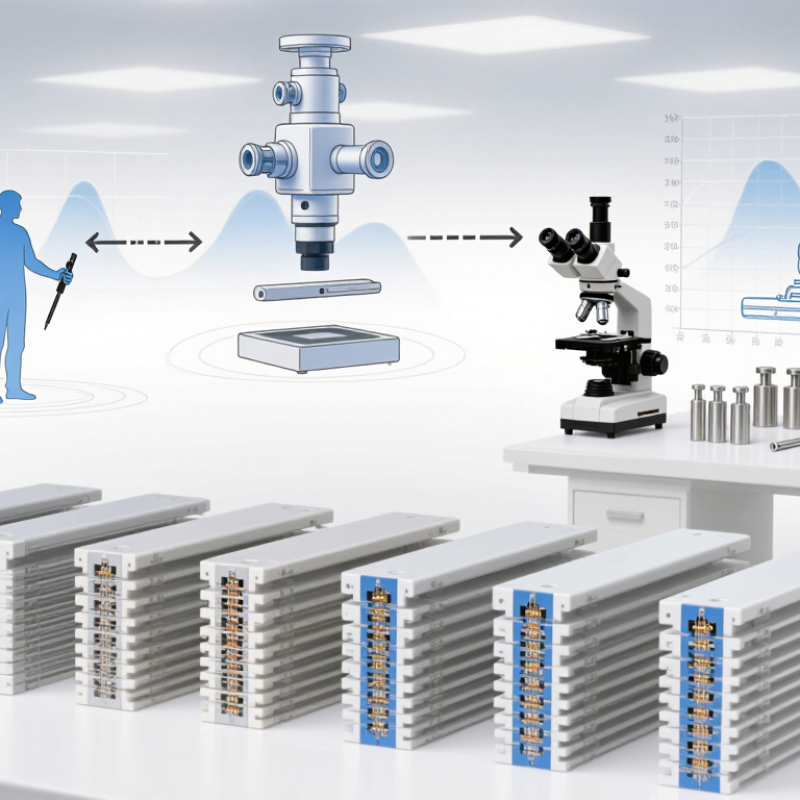
Choosing the best piezoceramic actuator manufacturer in China requires more than comparing catalogue prices. The useful question is whether published motion data survives real test conditions. A capable supplier should show nanometer resolution, not only nominal positioning claims. Ask for resolution measured with a calibrated interferometer, defined load, bandwidth, and controller settings. Resolution is not the same as accuracy. That distinction matters.
For fine alignment, a 0.1–100 μm stroke range can cover tiny corrections and larger optical adjustments. However, full stroke often reduces usable speed or force. Test reports should identify preload, voltage range, hysteresis, creep, and ambient temperature. During bench evaluation, monitor a target at one-second intervals, then repeat at kHz sampling. This reveals settling behavior that a single position graph may hide. Small details matter.
A kHz response is valuable for vibration control, fast shutters, and dynamic focusing, but resonance can create overshoot. Request frequency-response curves, not a single maximum frequency. Check connector design, insulation, cable motion, and thermal drift before installation. In practical trials, mounting stiffness changed our results more than expected. We initially blamed the actuator. That was a mistake. A reliable manufacturer should support repeatable testing, traceable calibration, and clear operating limits, even when the data looks less impressive.
China’s Manufacturing Landscape: Materials, ISO 9001, and ±10% Tolerance
China’s Best Piezoceramic Actuator Manufacturer?
Choosing the best piezoceramic actuator manufacturer requires more than comparing prices. In practice, material consistency often decides performance. Most actuators use PZT ceramics because they provide strong displacement and stable electromechanical response. Lead-free ceramics are also available for specific environmental requirements. Small differences matter.
A capable factory controls powder mixing, pressing, sintering, and electrode application. Each stage can influence capacitance, blocking force, and service life. I would ask for material data, batch records, and sample test results before approving production. ISO 9001 shows that a quality management system exists. It does not automatically prove excellent actuator performance. A reliable manufacturer should connect process records with inspection results. Paperwork alone is not enough.
The phrase ±10% tolerance needs careful clarification. It may describe displacement, capacitance, resonance frequency, or another parameter. These values are not interchangeable. A buyer should request the test condition, measurement method, and acceptance range. For example, displacement measured at one voltage may differ under another load. That question matters. Some suppliers quote ±10% without defining the reference value, which creates avoidable disputes. A stronger supplier will provide drawings, inspection reports, and calibrated equipment records. Even then, samples may not represent every production batch. Manufacturing has variation.
China’s Piezoceramic Actuator Manufacturing Landscape
Representative piezoelectric coefficient values for common PZT material classes, shown with a nominal ±10% engineering tolerance band. Values are material-level references and do not represent any company or brand.
How to read the chart: d33 is the piezoelectric charge coefficient, measured in pC/N. Higher values generally indicate greater charge response, while actuator design also depends on field strength, blocking force, stroke, temperature stability, and mechanical integration.
ISO 9001: ISO 9001 certifies a quality management system rather than a specific material performance level. Supplier certification, process controls, inspection records, and actuator tolerance capability should be verified separately.